Personal Balance Sheet (Part 2)

Hi there. Beggar King at your service.

Moving on to part 2 of personal balance sheet. Do read part 1 if you haven’t already done so.

In part 1 I explained how I calculate my monthly/yearly net income. Here I shall explain where I put them. Without further ado…
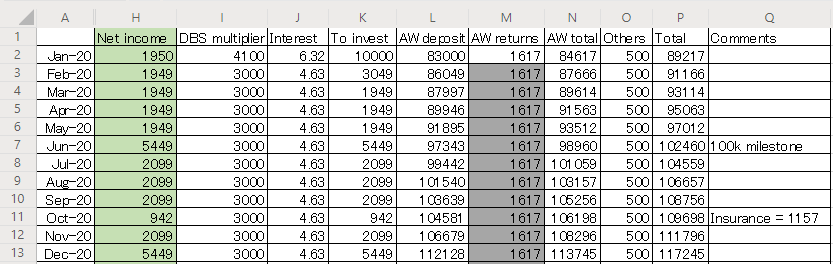
Image 1 : Home of my kawaii munny-chan

Savings Account

Most people probably put their money in savings account, such as DBS Multiplier or UOB One. It’s the most brain-dead way to earn some interests on your savings, and admittedly I was guilty of relying solely on them for the longest time. No longer do I endorse savings accounts, and I will explain that in my very next entry.

If net income DOES go entirely into savings account, savings account is simply “=savings account’s previous cell + net income“. If net income is column H and savings account is column I, it would be I3 = I2 + H3. I2 is the initial balance, which has to be input manually.

Else, just adjust the percentage of net income accordingly.

Savings Account Interest

In part 1, I explained net income, however that was only active income; income earned by trading your precious time. That means slaving working.

This is passive income; income earned by letting munny grow itself. Savings accounts ought to provide anywhere between 1% to 3% of passive income annually, which divided by 12 gives 0.0833% to 0.25% monthly. Singapore’s annual inflation rate is usually around 1-2%, so just having a good savings account is enough to beat inflation.

For this column, input this formulae “=savings account cell*interest rate/12″. For me it’s =I2*.0185/12, as 0.185% is what I get from DBS Multiplier. Then, add the result of this cell back to net income. With this, net income has become its final form (passive + active income).

Note : Interest compounds. 1.85% interest on $10000 over 10 years doesn’t simply give 10 times of $185, which is $1850. It actually gives 1.0185^10*$1000 = $2012, which is $162 more than $1850.

To Invest

This column is for munny to be invested. For me, this is equals to my net income, as I invest all 100% of my net income. If you wish to invest anything less than 100%, just input “=net income*0.x”, where 0.x is the percentage of income you wish to invest.

Investment

Add “To Invest” into this via formula “=investment’s previous cell + to invest“. Insert more columns as necessary.

I do passive investing, which is an investment strategy to maximize returns by minimizing buying and selling, via Autowealth. It is a robo-advisor, which is another a huge topic for another day. Currently almost all my munny are here.

There’s also stuff like Bitcoin and whatnot. Insert more columns as necessary.

Investment Returns

The passive income from investment, which comprises of gains (or losses) from investments, as well as dividends paid out. As of now, I got $2000 out of Autowealth in just 1.5 months. Will go into details when I write about Robo-advisors.

As there is no way to project returns from investments, I take the return from the end of the previous month for current and subsequent months.

Robo-advisors automatically reinvest dividends, so there is no need to add returns to net income.

Investment Total

This is simply investment + investment returns.

Other Money

This column is for all other places you put your munny. Namely :

  • Cash in your wallet
  • Foreign currency you exchanged in preparation for an overseas trip
  • Deposits in digital wallets (Steam/Amazon/Youtrip)

For me, I use this wonderful app called Youtrip. It is a credit card with a foreign currency wallet which allows one to convert currency with no conversion fees and at close to real time exchange rate. As I shop from Amazon Japan and other Japanese online shops frequently, I keep $500 SGD worth of Japanese yen ready at all times. I do this by regularly checking the JPY/SGD forex and exchanging for JPY when it is weak against SGD. This allows me to always shop with yen exchanged at a really cheap rate. Youtrip is a topic for another day as well. There sure are a lot of topics to cover, aren’t there. 😮

It’s a good idea to keep this low, as the munny here isn’t making more munnys. No piggy banks, no stashing under pillows!

Total Savings

And finally here we are. Total savings is the sum of savings accounts, investment total, and other money. There you have it. This is your liquid net worth. There’s actually CPF as well but there’s no easy way to tap on it so it’s not exactly liquid.

Comments

This is just a column for any comments you may want to write down, such as overseas vacation dates or insurance premium payment date. Anything goes.

AND that is all! That was… long.

Personal Balance Sheet Summary

  • If all incomes and expenditure are correctly inputted, and you stick closely to the plan, you will definitely get your projected savings.
  • Set short term goals, and achieve them! You will be motivated to keep this going forever.
  • If you fail to achieve a goal, it’s likely due to not adhering to expenditure, or perhaps due to some major unforeseen expenditure. Readjust expenditure and goal realistically.
  • There are many places to put your savings. Don’t just keep them all in a bank. Start by investing a little. It is never too late to start. 🙂
  • Remember, even if you can only save $10k a year, that’s still $100k in 10 years, and $300k in 30 years. That is enough to generate some seriously badass interests/returns. Possibly enough passive income for a comfortable retirement.
  • Feel free to customise the balance sheet as you see fit. Mine is only there to serve as reference.

Personal Balance Sheet (Part 1)

Dear Diary, it’s the Beggar King.

Since I’m still pretty excited about this blogging thing, I am writing this right after the introduction. I hope this lasts…

I started working very late compared to most people on the planet. At 27 years 3 months old, I was so far behind everyone else, it ain’t even funny. I had to compensate by being smart with munny. And that brings me to the topic…

Today I wanna talk about how I keep track of my munnys.

About a year and half ago, that’s a year and half after I started working, I randomly decided to open up an excel sheet to write down a balance sheet, and have been maintaining it since. Yeah, you might think I didn’t have anything better to do, and you would be right. I can no longer remember what my motivation was at that point of time, but me thinks it doesn’t matter anymore. I formed a good habit, and that’s what matters.

I successfully predicted how much savings I would have today since a year ago, with an error of only about $1000. Stonks.

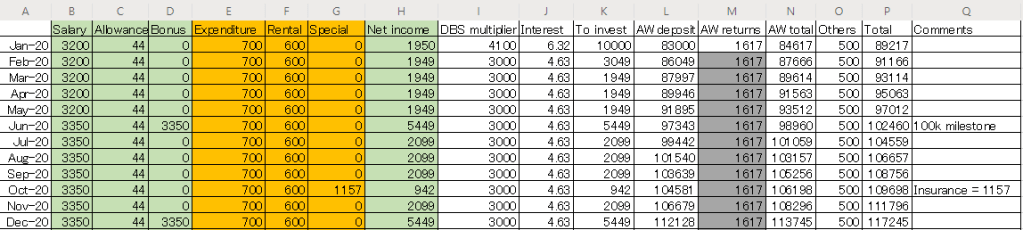
Beggar King’s balance sheet of 2020 (projected)

This is how I do it. Just good ol’ Excel. There are probably plenty of budget planner apps out there, but what can you do, I’m old fashioned. #Boomer

To break it down… I start by figuring out my net income each month. This is simply cash inflow – cash outflow.

Inflow : Salary + allowance + bonus

  • Salary : Not much to explain here. For Singaporeans, this is 80% of your salary on paper. The other 37% goes to CPF. I don’t take CPF into consideration as I have no way to tap on it yet.
  • Allowance. I have transport allowance. Others might get meal allowance and whatnot, but that is all I get. I separated it from salary as they are not factored in bonus salaries.
  • Bonus : Additional salary. Varies greatly between individuals, but I get at least 2 months a year.
  • Other income : If necessary, you could also include another column for “other income” here. Irregular income from outside your day job such as side hustles or Youtube. For me, I sell games on Carousell and make a small amount of money, like $50 a month. It’s quite negligible so I did not include it. If I start making about $100 a month from side-incomes I would add a column for it.

Outflow : Regular expenditure + mortgage/rental + special expenditure

  • Regular expenditure : All fixed monthly expenditure. Food, mobile data, hobbies, and so on. Mine looks like this.
Beggar King’s regular expenditure
  1. Mum : I only give mum $100 a month. I told her right at the start that I want to save up a huge amount of $$$ to buy a house first. The same amount of money is worth a lot more in my hands than in hers.
  2. Food : I spend $300 for food a month, about $10 a day. I don’t eat breakfast, so that’s basically $5 for two meals. That’s not too hard in Singapore. I almost don’t ever buy drinks; I carry a bottle of plain water wherever I go.
    I do eat more expensive stuff occasionally, but I would compensate for it by eating cheap stuff another day. This is just a general rule of thumb; I don’t stick to it that much. If I do go over $300, there’s the “misc.” expenditure to help cover it.
  3. Hobbies : This should be the largest component for most people’s regular expenditure, as is mine. I’m a pretty hardcore gamer, so a big chunk of my expenditure goes to physical/digital games, as well as arcade gaming. This is the one and only thing I splurge on, although I have learnt to make money out of my hobbies not long after I picked up this hobby. I do so by buying games cheaply and selling them for good profit, with about 20-40% markup. I think anyone can do this with any kind of physical items if they bother do.
  4. Misc. : Miscellaneous expenditure is expenditure I can’t predict. Things like weddings, red packets, clinic visits, overspending, and so on. Put a bigger number here if you can’t estimate your expenditure well, or if you have a tendency to spend impulsively.

Generally, you should try to be very conservative with your expenditure estimate. It’s too easy to overspend. You could add 10% of your initial estimate to misc. Or just add 10% to every category. Accuracy is key here.

  • Rental/mortgage/loans : This is for rental/mortgage or any other kinds of loan payments. You could split up loans into separate columns. Even though this is also regular expenditure, there is not much you can do to reduce it, hence the separate column.
  • Special expenditure : This will be relatively large, irregular, and/or unavoidable expenditure. Such as buying a new phone, a new PC, or insurance premium payment. Unlike “misc.”, it should be for large expenditure, because it can really rekt your net income of that month. Having a separate column makes it more visible, and helps draw your attention to it whenever you look at your balance sheet.

After you have gotten all of it down for a month, continue by filling as many rows as you desire. For a start, perhaps you could fill up from Jan-Dec 2020, like in my example. You will now have your monthly net income for the entire year. Sum those up, and you will have a very simplified total savings for 2020! If your estimates are good enough, you ought to come within +/- 10% of the end result come December.

It’s also possible to start from the end, and work backwards. Write down a target savings for December, fill in the cash inflow, and calculate the resulting expenditure for each month. Adjust components of expenditure until it is equal to the resulting expenditure, and them just stick to the plan.

Long term goals are good to have. For example, mine are :

  • $100,000 by 30 years old (almost achieved)
  • $250,000 by 35 years old. Buy a house, rent out 2 rooms.
  • Retire by 40 years old with $500,000, and have a monthly passive income of $3000-4000 from investments and rent.

I am absolutely certain that I can achieve my goals, because I have almost achieved one of them, and the next two are simply taken from the balance sheet projected 5 and 10 years ahead. Achieving them is just a matter of sticking to the plan. Also, planning goals in short intervals makes them less intimidating, and makes expenditure easier to adjust if necessary. Why not set some goals for yourself? It’s surprisingly fun! 😀

I shall move on to the remaining columns another day~ Ciao!

————————————————————————————————-

Beggar King notes:

  • It might sound simple, but it is really quite a challenge to figure out all sources of one’s expenditure. Perhaps you could try to note down all your expenditure for a month, or keep all receipts. One thing I do is to buy everything with a credit card, so I can easily check all my expenditure on my banking app. If you use cash, you can easily lose track of where your munny went. Although credit cards do come with many problems, especially with people with no discipline.
  • It’s okay to ignore inflation. Singapore’s savings accounts have good interest rates that easily beats the low inflation rate. More on this topic another day.

Greetings from the Beggar King

Welcome to my humble abode. Greetings. I am the Beggar King, descended from poverty heaven to spread my miserly gospel far and wide.

This is the first page of my diary. A diary about… *drum roll*… personal finance.

To summarise my existence very briefly – I am an ambitionless, young Singaporean man facing a quarter life crisis, and my only goal in life is to save up enough money to buy a house by 35 and retire by 40 with a good amount of passive income; all so I can sleep and play video games all day long. Probably not the most interesting description of a person you have ever seen, but that’s the Beggar King for ya.

I decided to start this blog, because I realised that my Beggar King Policies™ might be able to help out poor souls out there. Poor souls who have to let out deep, tortured sighs when looking at their account balance. Not just my fellow country mates, nossir, but every financially-challenged human out there.

Unlike countless other personal finance blogs which try to speak to the general public, I want to differentiate my blog by putting heavy emphasis on my own saving methods, which are pretty extreme. I am quite certain that few people in developed countries live the way I do.

I was partially inspired by the Woke Salaryman, who I recognised as a kindred spirit the moment I saw his blog. I certainly don’t have his talent of drawing, but I do have my Beggar King Policies™, which I’m proud to say are mine and mine only…!

So how money-savvy am I exactly? It is rather embarrassing, but I suppose I can’t get anywhere without first laying the numbers out.

Here’s my track record so far :

  • I have $89,000 of liquid assets now. Meaning, cash and stocks combined. I will hit that sweet $100k with certainty by June. If I don’t die or suffer a major accident, that is.
  • As of today, I have worked for exactly 3 years. I had $3,000 in mah bank when I started working, which means I saved $86,000 in 3 years. That’s about $28,666/year.
  • I’m just an average employee earning average salary. $3500 after graduation, $4000 now. Objectively speaking it is slightly above the average, but for the school and course I graduated from, it is near the rock bottom. Oh, I graduated from a renowned university known for its Kukubirds, a rare species of birds. 🙂
  • When I just started working, my monthly expenditure was about $300-350. Take that off my $2850 take-home pay, I was saving about 88% of my take-home salary.
  • I have moved out for quite a while, so I have an added expenditure of $600 for rent, plus I gotta pay for all my meals. I am only saving about 63% of my salary now.

Some additional, non-track record stuff perhaps I should clarify.

  • I was from a pretty poor family, by Singapore standards. $2xxx ~ $3xxx monthly income for a family of 6 for a good chunk of my life. I guess becoming the Beggar King was my destiny. I was used to being poor so spending money never became a habit.
  • I have been single since I started working, so my expenditure over the last 3 years was mine alone. It sure is cheaper to be #ForeverAlone though. :’)
  • I don’t have a home to live in, so I have no choice but to rent.
  • I actually enjoy saving money and researching on ways to save money. It’s sort of a hobby I suppose.

Say, were my salary $1000 lesser, let’s say starting at $2500 ($2000 take-home), and currently $3000 ($2400 take-home). If I lived the exact same way, I would have 40.6*$1000*0.8 = $32,480 lesser savings. So I would have $56,520 now instead of $89,000. Well, it would actually be a bit lesser than that due to having lower interests, so maybe $55,xxx instead. On the other hand, I would have been even more of a money-pinching bastard if my salary was lower, so my savings would be higher, say… about $60,000. My point is, having a lower salary is not an excuse not to save.

And also… no, living in Singapore, the supposedly most expensive city/country in the world, is certainly no excuse to being poor.

I am aware that my lifestyle may appear insane to some, but I am certain anyone, high or low SES, can take away something from it.

Here are some topics I plan to write about :

  • Personal balance sheet
  • Savings account
  • Insurance
  • Housing
  • Credit card
  • Foreign currency
  • Expenditure
  • Side hustles
  • Useful apps
  • Idiot-proof investment
  • Beggar King’s life in Japan

… And more. There’s so many things to talk about when it comes to saving money.

Let’s get on to the first topic right away. Personal balance sheet ahoy!

Create your own website, free on WordPress.com.Create your own website.
Start free